Port Watchers № 5
Some personal news: I’m leaving my job and going freelance later this year. I’m not going to talk about exactly what kind of freelancing, because it’s (mostly) not the kind of thing you signed up for in this newsletter. Later this year, when there is something to link to, I’ll throw in a link. (And if you’re actually curious, I’m happy to talk about it. Just reply to this email.)
Ben Kettle recently posted Autogenerating a book series from three years of iMessages. On the off chance you saw it already, you probably predicted it would appear in this newsletter.
A few years ago, I cleared out nine years of messages to save space on my phone. But I saved a copy of the iMessages database, with a project exactly like Ben’s in mind. Will I ever actually make that book though?
Any pipeline that ends in “to printed book” is Port Watchers material. “Website to printed book” is one of them, the one I’ve put the most work into. Other interesting possibilities are “Phone contents → printed book” and “Directory contents → printed book”. Imagine being able to point at a folder on your computer and say: “give me a print-ready PDF containing everything in this folder, with the directory listing as its table of contents.” — !
My interest in archiving digital things as books probably crystallized when I first read with Tom Armitage’s 2012 post A Year of Links, in which he wrote some code to produce 8 print books out of an XML archive of Pinboard links by way of the Prince typesetting engine.
I find there are two big obstacles to building these kinds of pipelines. The first and biggest is the effort involved. Every time I do something like this it seems I’m starting over. I get better at building the machine, but there always end up being reasons not to reuse the machine I built last time. Tools change, methods change, and each thing, inevitably, kind of demands its own special treatment.
The other reason, though, is an apprehension about the inherent value of personal preservation work. This apprehension is probably the normal person’s starting point, and the reason so few people have book-making as a hobby. Your text messages, your blogging — what if their purpose was always inherently ephemeral, the same way the purpose of cooking and eating is inherently ephemeral? You made the thing because you needed it then, not because you need it ten years from now. And of course, some text messages are definitely better off fading into the past than preserved in print. As I say, this is obvious to most people; to me, the make-all-the-books guy, it is a suspicion only lately arrived-at.
New Cule
The 👉 manicule is probably my favorite archaic typographic mark.

I had reason, recently, to wonder — has anyone yet designed a feminine version of this pointing hand mark?
As far as I can tell — yes: exactly one person has done so… but as a woodcut, not as part of a digital font.
They have christened it, appropriately the femicule.
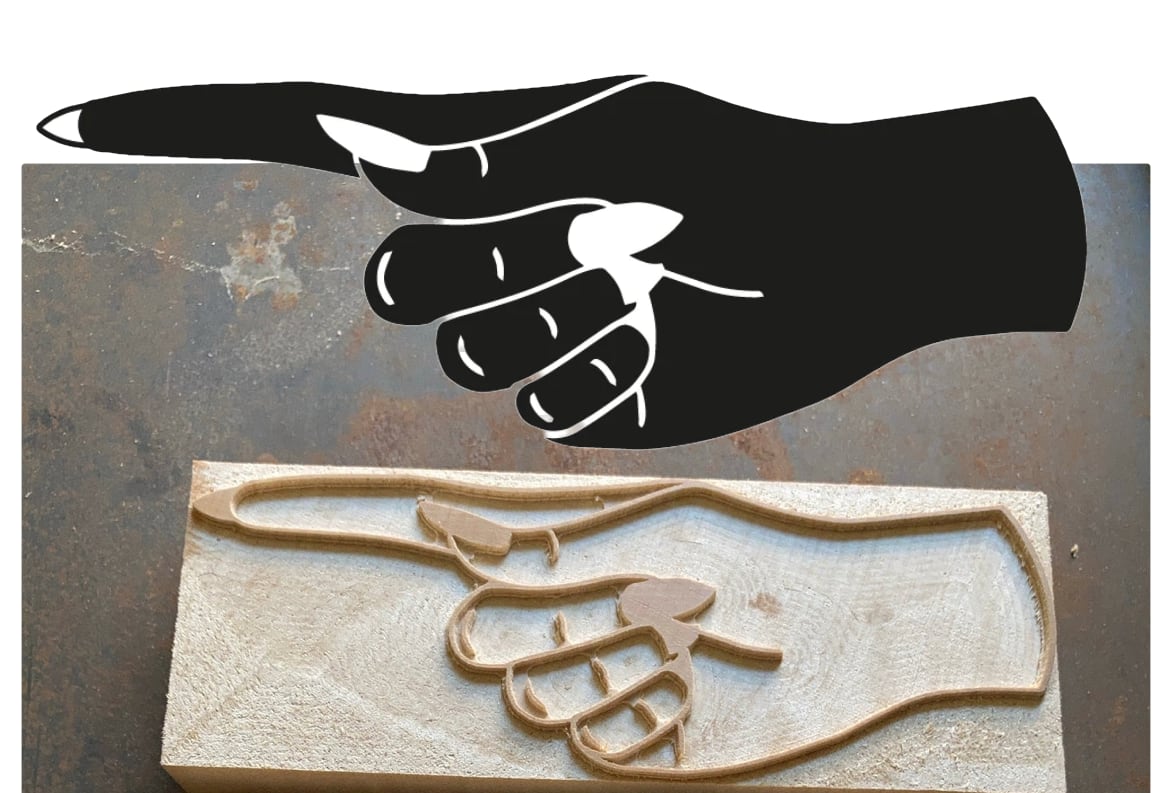
It’s, well, striking! Not quite there though. To my extremely untrained eye, it looks like they took a normal, angular male hand and simply added long pointy nails. Of course, to give a typographic mark clear feminine distinction at a 12-point size, good nails are probably going to be indispensable.
Hopefully more type designers try their hands at the femicule in future.
That’s all for now! More soon, but not sooner than a month from now. If you have anything to say or share, just reply to this email, or find me on Mastodon (@joeld@tilde.zone) and Bluesky (@joeldueck.bsky.social).
— Joel