Port Watchers № 9
At one time, ham radio was a brand new technology, and in its early days there was a ham radio “scene”, a community of enthusiasts experimenting and comparing notes.
During that first scene, there was no prior art; any new thing you figured out wasn’t just new for ham radio, it was potentially an advance in communication itself. Ham radio was fresh technology; everyone knew it, and everyone knew that everyone knew it. You might be kind of a nerd for being into it, but you were a cutting-edge nerd.
There is still a ham radio scene, but of course it feels different from that original one, because the world has moved on. You can still be a ham radio nerd, but you can’t occupy the leading cultural position that those in the first scene could. If you’re into ham radio in the 21st century, it’s because you find the tech itself interesting or fun. It’s not to solve new problems, but to work through a syllabus of problems that were solved long ago.
The “personal website” scene is in the late stages of this same transition.
Many of us remember when blogging was new. In the early 2000s, it wasn’t just that the tech was interesting, it was that we all felt the rush of being at the front of the culture, and nothing was settled; any blog post about blogging might be a real step forward.
There are still elder millennials who miss that energy, who are coding up projects trying to “recapture the era” of the early web. But you can’t go back. You can’t recreate a cultural moment with lines of code. You can still be a web publishing nerd, but you have to be real with yourself: what you’re doing is, both culturally and technically, akin to letterpress printing or model trains: something you do for the pleasure of operating the machine, rather than for its utility or its novelty. It used to be marginal because it was new; now it is marginal because it is old. Best to embrace it.
Welcome to Camp
To be camp is to present oneself as being committed to the marginal with a commitment greater than the marginal merits.
— Mark Booth, Camp (1983)
In March, on my 45th birthday, I finished my own new website kit, and I called it Camp.
Camp is the web-publishing machine I’ve always wanted to exist for my own websites. It’s a nice blend of maximal typographic control with an app that hides all the publishing complexity when I just need to write. I’m using it right now. Here is a screenshot!
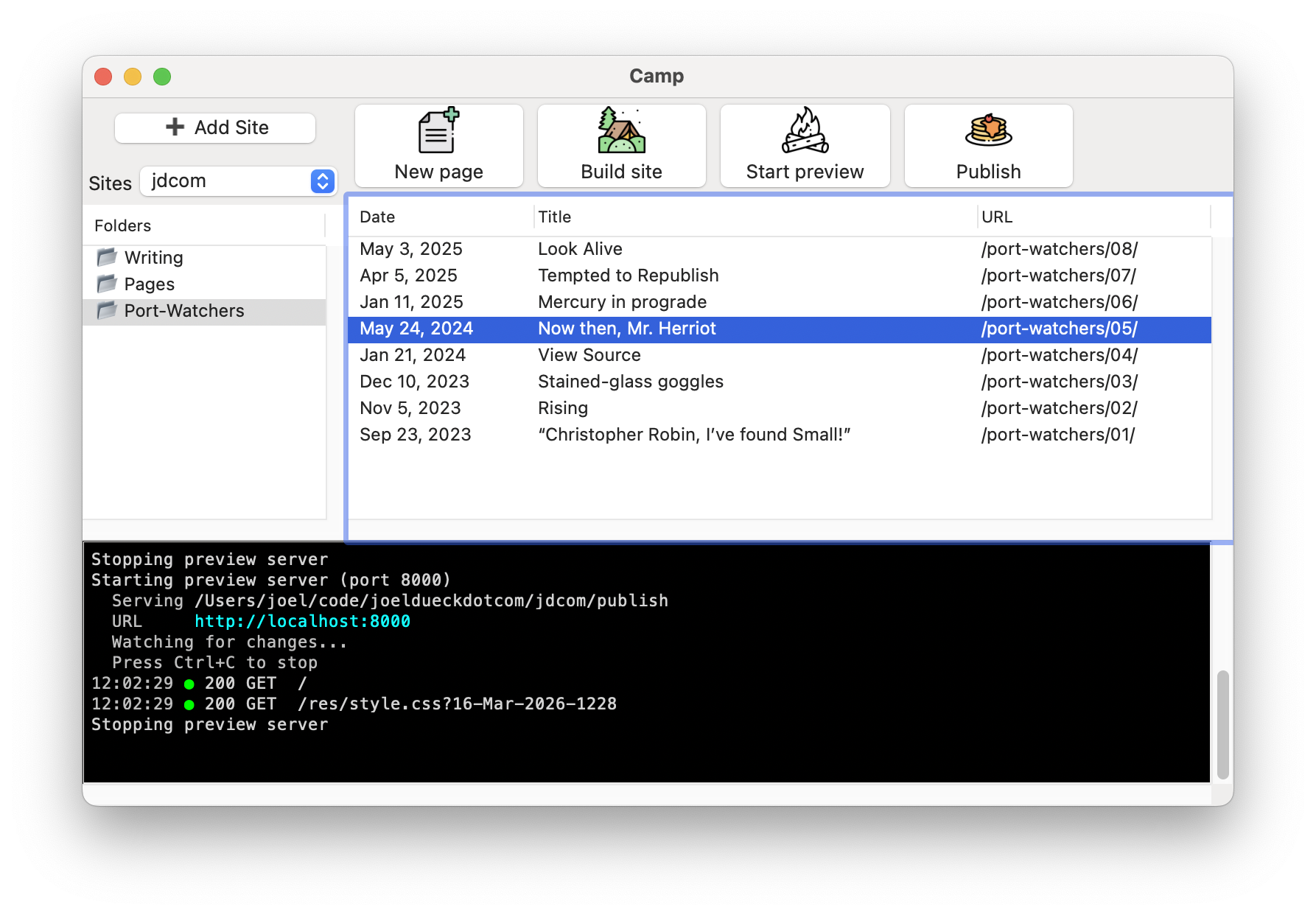
You can read more about it, and watch a quick intro video, at the link.
OK, announcement done — why? I’m proud of Camp, and I really enjoy using it. But it’s not for everyone; in fact, statistically, it’s for hardly anyone. There may not be more than four (?) other people in the world for whom it would be a natural fit (but check for yourself). I’m only “releasing” it because, well, doing so helps me maintain certain good habits.
But I hope you realize: you can make your own thing that is as narrowly tailored to your preferences as Camp is to mine. You needn’t use anyone else’s CMS ever again.
The funny thing is, in 2026 it is easier for you to create a new personal website than it has ever been. With your AI clanker of choice, you can make — and maintain! — a website whose style and structure are maximally unique and un-Squarespace-like, with almost no friction. So, at a time when having a personal website was already kind of weird, there is suddenly nothing to prevent it from getting supremely weird. Or, at least, even more tastefully personal.
Even better — maybe you already have an old website limping along somewhere and it’s so old and fragile you’re afraid to touch it. You can just talk to the clanker about cleaning it up and liberating it from WordPress or whatever the source of that dread is. It will do that work for you. If you don’t have a website — maybe you don’t even know HTML — you can ask the clanker to help you set up the barest possible site, as if you were at summer camp putting together a rocket kit. Do all the steps manually if it makes you feel better.
I’m collecting examples of personal website liberations, here are a couple for you.
Around the same time I was finishing up Camp, Paul Ford was rebuilding his extremely complicated and huge old blog:
A few months ago I realized that I had stuff scattered all over the web and I wanted it in one place, especially in the age of AI grabbing and compressing the world’s data into a universal blob. I want my own little brain castle, you know? I want to own my blob.
At the same time LLMs mean that absolutely prohibitive tasks, like converting a 25-year-old messy XML database, or downloading a bunch of newsletters from many different websites and cleaning them up, or setting up HTTPS, or configuring a dev server, or setting up caching, or producing RSS, are far more manageable—you don’t need a framework or a CMS. Major efforts are reduced to tasks.
I didn’t intend to launch a living blog again. That’s a side effect of me trying to build a good hierarchical content manager for my personal archive. In doing so I accidentally built a CMS. That’s vibe coding! Once I saw that text box I had to type into it. Then I had to debug it on mobile and make it work when the subway goes underground. And now I have a blog.
Paul’s blog was one of the first I ever found, and it was the gnarliest, woolliest thing I’d ever seen — see exhibits A and B, circa 2001. Hundreds of posts, arranged, not in your typical bloggish chrono stream only, but in a thicket of hierarchies and code. By his own lights, it was difficult to use. He left it untouched for years. And yet a few days or weeks with the clanker and it has eucatastrophically re-emerged as everything: it has all the content, all the old hierarchies, all twenty-three thousand of his tweets, all his articles published in a dozen+ print magazines and newspapers — and he’s writing new posts. See: you can have it all.
Venkat Rao did the same for his blog just this month:
My old WordPress blog, Ribbonfarm, which I retired in 2024, has now been thoroughly reimagined, rearchitected, and rebuilt as an archival, static museum site.
…It is now a bespoke static site, ridiculously over-scaffolded with AI affordances lurking in the margins and menus. It took less than a couple of hundred dollars in tokens to build, and provided me with a lot of fun over several months.
It has already more than paid for itself, since it is essentially free to host in its current form, and I was paying ~$1500/year in hosting fees to host it as a live WPEngine WordPress site (even post-retirement, it remained high-traffic enough it needed high-end hosting to be hassle free). Big debt of gratitude to the WordPress ecosystem for serving me so well for so long though.
The decision to keep the basic surface appearance the same was partly pragmatic (obviously, old link structures had to be preserved) and partly aesthetic. It’s fun to engineer an uncanny experience where the surface feels familiar, but something tells you an alien logic has taken over the innards.
Venkat took his site liberation/revamp in quite a different direction. He’s pointedly not using it as an active blog — it’s intended as an archive only — but it’s an archive you can chat with. It turns out ≈1,100 lengthy, literate posts is enough to build a bot that can hold up its end, so to speak. I asked it about the subject of this newsletter and the results were interesting enough that I saved a copy.
As far as I can tell, neither of these guys are sharing the code behind these sites…and that makes sense. The tools they’ve created aren’t general-purpose. If I had better discipline, I would probably have kept Camp to myself as well (Creative Opacity). Like Camp, I hope they inspire you with the new state of the possible.
A few points about stuff:
-
This isn’t, and won’t be, a newsletter about AI. The promises in the Port Watchers prospectus still hold.
-
An extrapolation: the AI social scene in 2026 feels a lot like the blogging scene circa 2004 — nothing is settled, new ideas coming from everywhere. So by 2048, this “AI scene” will likely have reached its own ham radio stage. (This is an observation about the swarm of individual, independent contributors — not the commercial environment, which is quite another thing.)
-
I find that heavy AI use (mostly in my professional life, though again, not for writing) reduces my ability to perceive the world in vibrant literary color (Prompting vs. Perceiving), so I make a point of doing some things the old, hard way.
-
I still tend to agree that Waldenponding is overrated as an “attitudinal foundation for relating to society and technology”. “Imma disconnect from everything” would, for me, be the easy cop-out.
That’s all for now! More… at some point.
I welcome replies and I’m interested in your projects. If you have anything to say or share, just reply to this email — or find me on Mastodon (@joeld@tilde.zone) and Bluesky (@joeldueck.com).
— Joel